

When we read the recent Independent article about “Lucy” discovering her chronic kidney disease (CKD) diagnosis on the NHS app, our hearts sank – but we weren’t surprised. This is a story we hear all too often from our own clients: a result pops up on a screen or arrives by text or letter, or the news is delivered “by-the-by” from a doctor or nurse, and the impact feels devastating.
A new CKD diagnosis feels scary. It’s completely normal to feel shocked, confused, or to spiral into worst-case scenarios – especially if you didn’t even know you were being tested, or you’re given no explanation of what it means.
If that’s you, we want you to know this: you haven’t done anything wrong. The way you found out isn’t your fault. While we can’t change how your results were delivered, we can advocate for better processes – and, right now, we can support you through this moment with empathy, clarity, and some practical next steps.
We’re kidney dietitians, and we help people like you every day. Our role is to replace fear with a plan, turn information into something useful for your situation, and walk alongside you while you regain confidence with food and everyday choices.
In this blog, you’ll find:
- Why it feels so hard to be diagnosed via an app, text, or letter
- A simple “first 48 hours” plan to help you feel more in control.
- Exactly what to ask at your first GP appointment so you leave with answers.
- Safe places to learn about diet for CKD (and what to avoid).
- The often-overlooked truth about diet and lifestyle
- Practical steps you can start taking when you’re ready
You’re not alone. Take a breath – we’ll take this one step at a time, together.
I’ve been diagnosed by an app or text
If you found out you have CKD because a result flashed up on your phone – or arrived in a text or letter – you’re not alone: this seems to be happening more and more. Technology has brought lots of positives to healthcare (quick access to results, easy prescription requests, appointment bookings), but some people are now learning about chronic health conditions like CKD without any explanation or next steps.
That’s hard to deal with because:
- There’s no human conversation to explain the diagnosis or answer the first wave of questions
- No guidance on what the result means for you right now and in the future
- No clear “what to do next,” which can leave you stuck in worry or Googling at 2 am
- It can feel dehumanising – like the compassion got lost in the technology automation
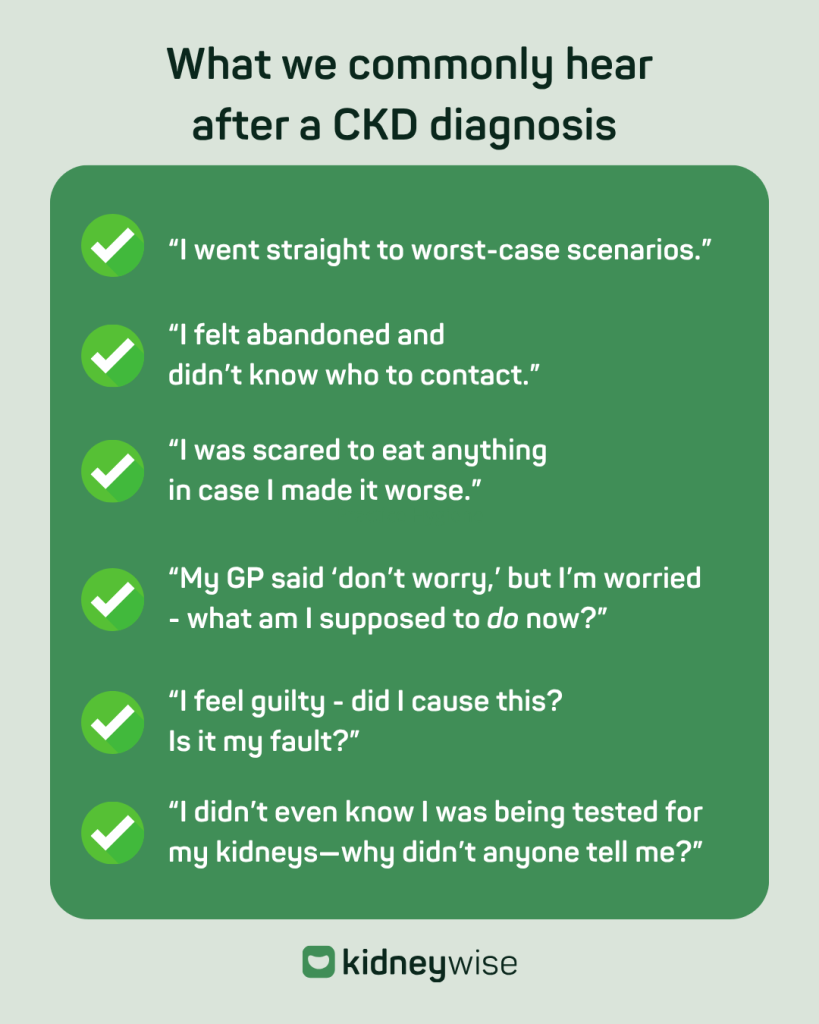
What we’re hearing from people:
- “It was like a bolt out of the blue”
- “I went straight to worst-case scenarios.”
- “I felt abandoned and didn’t know who to contact.”
- “I didn’t even know I was being tested for my kidneys—why didn’t anyone tell me?”
- “I was scared to eat anything in case I made it worse.”
- “My GP said ‘don’t worry,’ but I’m worried – what am I supposed to do now?”
- “I feel guilty – did I cause this? Is it my fault?”
Our take as kidney dietitians: We’re pro-technology when it improves access and makes life easier, but serious or life-changing results need a human touch – someone to add context, answer questions, and help you plan the next steps.
Regain control when you feel out of control
Take a breath – you don’t have to solve everything right away. The goal after your diagnosis is simply to calm the noise, gather what you need, and line up a plan.
Here’s a gentle, 15-minute reset that makes a real difference.
1. Take a deep breath
11% of the population has CKD Stages 3-5, so you’re not alone, and most will not develop kidney failure requiring dialysis or a kidney transplant.
2. Write your top 3 worries and top 3 questions
Getting them out of your head and onto paper lowers the panic and gives your GP something concrete to respond to.
3. Gather any results you have
Pop them in one place. The most helpful are:
- eGFR (estimated glomerular filtration rate) and creatinine: This measures your kidney function
- Urinary ACR (Albumin: Creatinine Ratio): This measures protein leakage
- Blood pressure
HbA1c: This measures your blood sugar control or your risk of diabetes. - Potassium: For your own peace of mind, make a note of your potassium levels. If they are within the normal range and a healthcare professional has NOT advised you to reduce the potassium in your diet, then please don’t change your eating.
4. Book or confirm a GP appointment (face-to-face if possible)
Tell reception you’ve had a CKD diagnosis and would like time to go through results and next steps. If there’s a long wait, ask about a telephone call first and a follow-up in person. We’ll share with you some questions you might want to ask later in the post.
5. Tell someone you trust – or find supportive company
Share how you’re feeling with a friend/family member, or join a moderated CKD community online for peer support (more details later). You don’t have to carry this alone.
Top Tip: What you don’t need to do right away
- A brand-new diet. You don’t need to overhaul your eating before you’ve seen your GP. Wait until you have found a trusted source of information about diet.
- A deep dive on Google. It’s too easy to stumble into scary, non-specific advice. We’ll signpost safe places to learn a bit later.
If you’ve been left confused by your kidney blood test results, download our FREE guide to help make sense of them.

Tech and healthcare
We’re big fans of technology when it genuinely helps people. The NHS app can be brilliant for day-to-day healthcare admin – seeing test results, ordering prescriptions, checking referrals, and managing appointments without sitting on hold. However, when results appear without context or an explanation, and diagnoses are given to you without support or a clear next step, leaving you turning to Google – that’s when fear spirals. That’s why we align with Kidney Care UK’s position.
Next, let’s make that first GP appointment really count – here’s exactly what to ask so you can leave with a plan.
Your first GP appointment after diagnosis
This is your chance to turn a scary notification into a clear plan. Bring your notes, any past results, and this set of questions. It’s completely okay to ask for a longer appointment so you have time to talk everything through. Here are some things you may want to discuss.
- Cause of CKD: It is likely that your doctor or nurse will not know the answer to this, but it is helpful to ask, as they may offer up some potential explanations.
- Blood pressure (BP): ideally measured in a clinic and discussed with a target and whether to test at home.
- HbA1c (blood test): screens for diabetes or checks diabetes control, which affects kidney health.
- ACR – Albumin: Creatinine Ratio (urine test): looks for protein leakage in your urine, a key marker that helps stage the risk of CKD progression and guides treatment.
- eGFR & creatinine (blood test): core measures of kidney function. It is likely your GP will ask to repeat your eGFR after three months to check the result, but they may have records of your eGFR results from one year ago or more.
- Kidney ultrasound/scan (if appropriate): may be used to check for any abnormalities in your kidneys.
- Referral to kidney specialist: If not, clarify what triggers a referral. It is uncommon to be referred to a kidney specialist in the early stages of CKD, so don’t worry if the answer is “no”.
- Diet changes: Ask for one or two priorities based on your results and history.
- Medication changes: Useful to know and why.
Before you leave, confirm:
- What happens next
- When to book your follow-up
- Who to contact if you have further questions.

Learning about CKD and nutrition
The internet can be a lifesaver – but also a minefield. When you’ve just seen “CKD” on a screen, it’s natural to search for answers. Here’s how to find the good information and sidestep the scary stuff.
How to spot trustworthy advice (your “trust filters”)
- Stage-specific: Make sure it matches your stage (e.g., CKD 3 vs. CKD Stage 5 on dialysis).
- Qualified authors: Look for registered healthcare professionals – ideally kidney dietitians and trusted organisations such as Kidney Care UK and Kidney Research UK
- Up-to-date: Check for a recent update.
- Plain-English and practical: Clear guidance you can actually use beats complicated rules every time.
- No hard sell: Be cautious if the page pushes miracle supplements, cleanses or books written by unqualified people.
CKD online communities
Online groups are wonderful, and can be a lifeline for support and shared experiences. Just remember:
- A diet that helped one person may not fit your blood results, CKD stage, or other health conditions.
- Dealing with your diagnosis alone is difficult and lonely. Use these communities for connection and support.
- They can be helpful for meal suggestions and recipes if you already understand the way of eating that is right for you, and you need inspiration.
What to avoid (common red flags)
- “Kidney detox” or “cure in 7 days” claims
- Blanket elimination lists that cut huge food groups
- Unqualified influencers giving medical nutrition advice
- Anything that makes you feel afraid to eat
Safe places to start looking for information
General information about a new diagnosis
- Kidney Care UK: reliable, patient-friendly resources and telephone support
- Kidney Research UK: trustworthy information about living with CKD
- National Kidney Federation: information and leaflets; run by kidney patients for kidney patients
Nutrition information
- KidneyWise: our practical nutrition guidance from us, registered kidney dietitians; plus blogs, free weekly email newsletter, meal plans and 1:1 support
- Kidney Kitchen: diet booklets to download and recipe inspiration
- Your local kidney dietitian unit: nutrition leaflets tailored to your specific needs

The overlooked truth - diet does matter in early CKD
Here’s the part many people don’t get told at diagnosis: what you do day-to-day really can make a difference. Diet and lifestyle aren’t a magic cure, but they do support your kidneys and your overall health – and that matters at every stage, including CKD Stage 3 and 4.
These are some of the common scenarios we hear from our clients about diet:
- No diet information was given at diagnosis, so you end up in a Google spiral
You find scary lists and start cutting lots of foods “just in case.” Most blanket restrictions aren’t necessary, can dramatically reduce the amount of foods in your diet, potentially leading to nutrient deficiencies, raise anxiety, lead to fear of food and loss of enjoyment of eating. Therefore, cutting out lots of foods can do more harm than good.
- Told to just eat normally, so you end up left with no guidance
Our clients hear this a lot after they get their diagnosis, and it’s well-meant – but vague, so it’s still hard to know what to actually do. - Conflicting advice on what to eat, so you end up just feeling confused
This can come from multiple sources on the internet, friends, or other people with CKD. Everyone’s blood results, health conditions, and CKD stage are different. Also, the information online rarely specifies if it is targeted to the earlier stages of CKD or the more advanced stages. This can lead to unnecessary restrictions.
What does help
Diet and lifestyle can have a positive impact on CKD progression and your overall health. However, think “less extremes, more patterns.” These are safe foundations to start with:
1. Nutrition: Start with the basics:
- Go easier on salt: Lowering salt helps with improving blood pressure, a major protector of kidney and heart health.
- Right-size protein and add more plant protein: Most people do well with moderate protein – enough, not excessive. Shifting some animal protein to plant proteins can be helpful.
- Dial down on highly processed foods: Cooking simple, well-balanced meals at home in place of ready-made foods more often supports weight, blood pressure and blood sugar.
- Only limit potassium or phosphate if advised: Don’t pre-emptively cut these out, as it depends on your blood results and your medications.
2. Stop smoking: Ask your GP for support options.
3. Move your body: Move your body every day; even short, regular walks help. KidneyBeam is a great resource to help you incorporate more exercise into your life (free resource in some locations).
4. Prioritise sleep: Develop a simple wind-down routine as a first step.
5. Manage stress: Try breathing, meditating, journalling or regular ‘me’ time.
Practical steps that feel doable
When everything feels overwhelming, simple beats perfection. Here’s a clear, kind plan you can follow if you’ve just been diagnosed:
1. Book/attend your GP appointment: Bring your questions and any results you’ve gathered. Ask for a longer slot if you need one.
2. Understand your blood results: Keep them together and track dates so you can see trends. Download our free guide to understanding CKD blood results with a bonus blood results tracker
3. Get support: Tell a trusted friend/family member how you’re feeling, or join a moderated CKD community for encouragement and connection
4. Spot unreliable advice quickly: Ask: Who wrote this? Is it stage-specific? Is it pushing a supplement or an expensive product?
5. Review your eating: Choose one food habit such as swapping high-salt products for lower-salt alternatives, aiming for 5 portions of fruit/veg most days or making 2 plant-protein-based dinners this week (beans, lentils, tofu). You can then build from there.
6. Pick one lifestyle habit: Focus on exercise, sleep or stress reduction to start with- whichever you feel you can work on first.
7. Be kind to yourself: You’re learning something new under stress. Small steps count.
8. Progress over perfection: Wins look like: one lower-salt choice, one calm question asked, one short walk completed. That’s momentum.
Key takeaways
✅ You didn’t do anything wrong: It’s the system.
✅ Take a breath to feel calmer: Spend 15 minutes booking a GP appointment, putting your results in one place and writing down some questions.
✅ You deserve clear answers: Ask your GP the questions you want answers to. Bring them written down so you don’t forget.
✅ Be smart about where you get information: Use safe, stage-specific advice from qualified healthcare professionals.
✅ You don’t need to overhaul your diet overnight: Pick one food habit to start and build from there.
✅ You don’t have to do this alone: Tell a friend/family member how you feel or join a moderated CKD community for support.
✅ Choose progress over perfection: Get rid of the perfectionism mindset and “I’ll start again on Monday” mentality and begin with small sustainable habits you can build on every day.
Want a bit of help personalising this?
Book a free 15-minute enquiry call with an experienced kidney dietitian to explore how 1:1 support could fit your goals and your life.
